 Rohan M.Mumbai
TMUA
3.0 to 6.0
in 14 weeks
Best value in the exam preparation spaceCompare
Estimates only. Your real TMUA score depends on how everyone else does.














average gain in points for 168 TMUA students, from their first full-length test to their latest.
That is about the jump from Durham to Cambridge.
| Share of the marks | Before | After |
|---|---|---|
| 0–5% | 0.4% | 0% |
| 5–10% | 0.9% | 0% |
| 10–15% | 1.9% | 0.1% |
| 15–20% | 3.5% | 0.3% |
| 20–25% | 5.7% | 0.7% |
| 25–30% | 8.4% | 1.4% |
| 30–35% | 10.9% | 2.7% |
| 35–40% | 12.7% | 4.5% |
| 40–45% | 13.7% | 7% |
| 45–50% | 12.5% | 9.6% |
| 50–55% | 10.4% | 11.8% |
| 55–60% | 7.8% | 13% |
| 60–65% | 5.2% | 12.9% |
| 65–70% | 3.1% | 11.5% |
| 70–75% | 1.7% | 9.2% |
| 75–80% | 0.8% | 6.6% |
| 80–85% | 0.3% | 4.2% |
| 85–90% | 0.1% | 2.4% |
| 90–95% | 0% | 1.3% |
| 95–100% | 0% | 0.8% |
Estimates only. Your real TMUA score depends on how everyone else does.
Rohan M.Mumbai3.0 to 6.0
in 14 weeks
Meera P.Bengaluru3.0 to 6.5
in 14 weeks
 Yousef H.Dubai
3.0 to 6.0
in 12 weeks
 Hana L.Seoul
5.0 to 7.6
in 11 weeks
Arjun V.Chennai2.5 to 5.5
in 11 weeks
 Sara M.Istanbul
4.8 to 7.9
in 9 weeks
Q1A harbor ferry charges a fixed booking fee plus the same price for each passenger. The table shows the total cost of two bookings. What is the fixed booking fee?
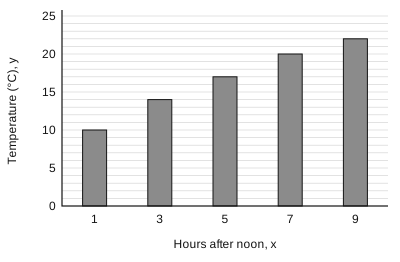
Q2The bar graph shows the air temperature , in degrees Celsius, hours after noon, for the times shown. The temperature at is greater than the temperature at . What is the value of ?
Q1A radioactive nucleus X decays into a stable nucleus Y. During this decay the nucleon number falls from 232 to 212, and 2 beta () particles are emitted.How many fewer protons does nucleus Y contain than nucleus X?
Q1For , the curve has gradient at exactly one point.What is the -coordinate of that point?
Q1A curve has equation . Find its stationary points and determine the nature of each.
Q1The equation has a root . Find the other two roots.
Q1A 0.40 kg trolley is pulled up a ramp at 30° to the horizontal by a force parallel to the ramp. It accelerates uniformly from rest to 3.0 m s⁻¹ in 2.0 s. A constant resistive force of 0.20 N acts down the ramp. Find the pulling force.
Q125.0 cm³ of sodium hydroxide solution exactly neutralises 20.0 cm³ of 0.150 mol dm⁻³ sulfuric acid. The equation for the reaction is shown. Calculate the concentration of the sodium hydroxide.
Q1Fill in the missing letters to complete the text.

Q1How can students have their orders shipped on time?

Q1Listen and repeat only once.
Q1Make an appropriate sentence.
The TMUA only marks the letter you choose. We read your steps from a photo or from the screen and mark each one. So a right letter does not hide weak reasoning.
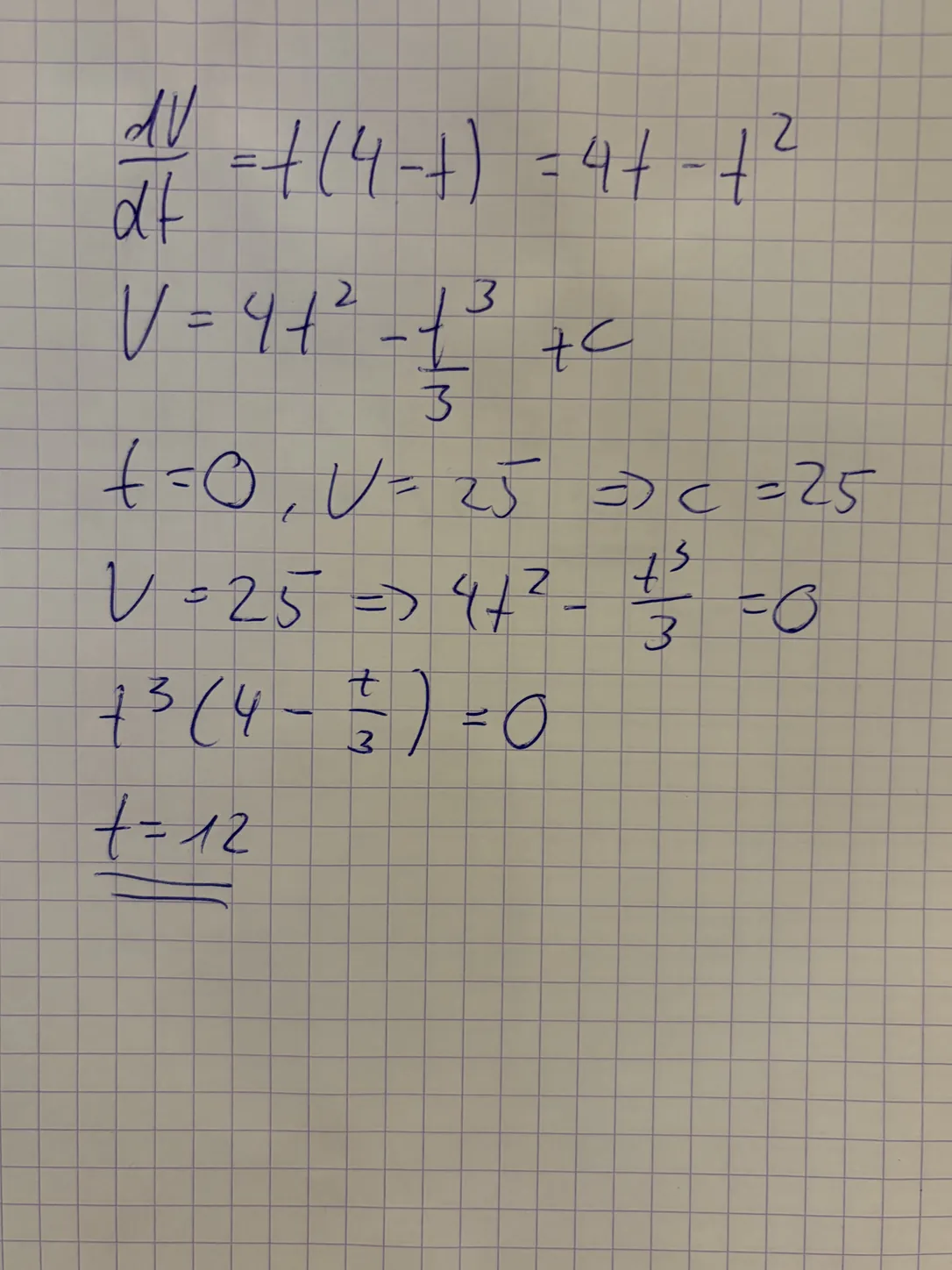
Oil is pumped into and out of a container. The volume of oil in the container is litres at time minutes after the pumping starts, and
When the container holds litres.
At what time does the container again hold litres?
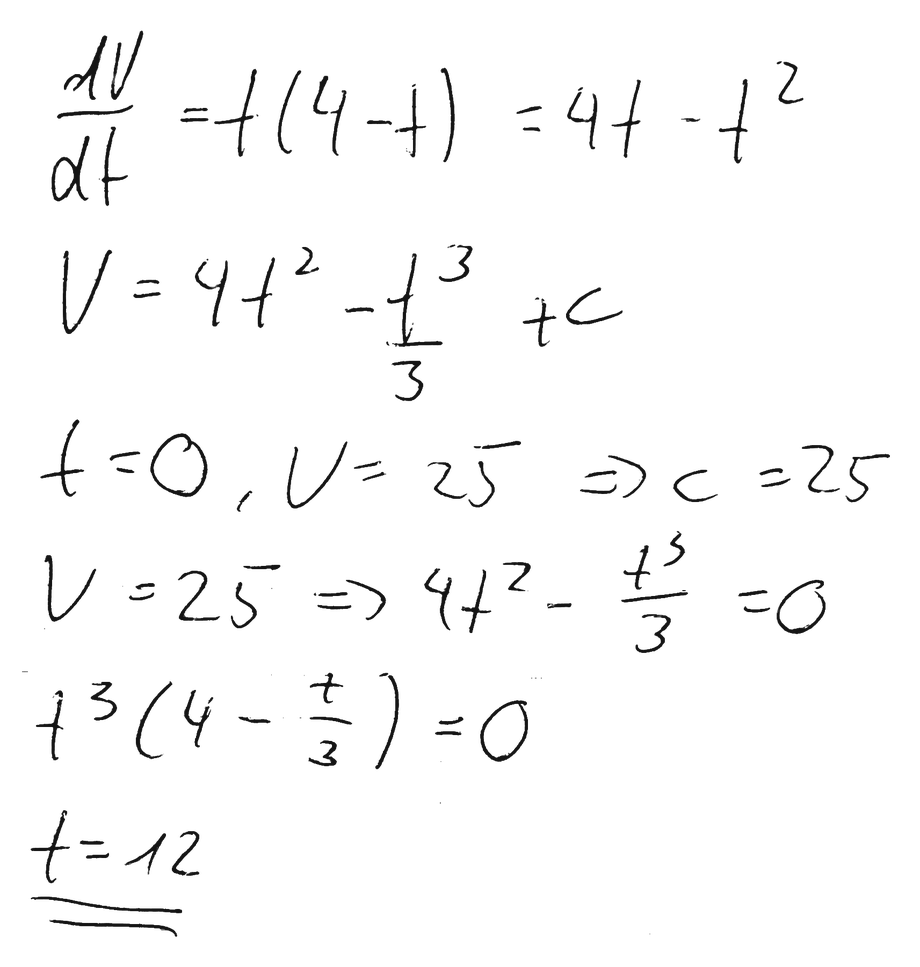
You integrated 4t as 4t² instead of 2t², writing V = 4t² − t³/3 + C, so the antiderivative is wrong even though you correctly used V(0)=25 to get C=25.
Can you show me my V next to the right one on a graph?
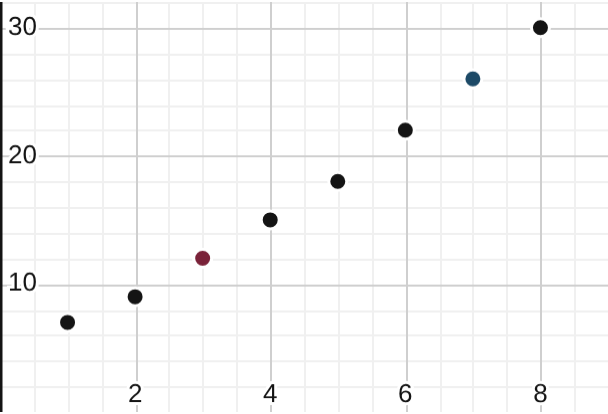
Good idea, a picture makes it obvious. I've drawn your V (4t^2 - t^3/3 + 25) and the correct one (2t^2 - t^3/3 + 25), both with the line y = 25. Both curves start at 25 when t = 0, but yours climbs much higher and only comes back down to 25 at t = 12, while the correct curve returns at t = 6. Yours is steeper early on because integrating 4t as 4t^2 doubles the rate of rise, which is exactly the missing half from before.
Each full-length test shows your score and your weak skills. It also shows where you lose time and the patterns behind lost marks. Your plan then works on them.
Swipe to see the full journey
You completed this test.
You completed this test. Open the report to review your score and feedback.
View summaryYour next full-length test checks your progress.
Practice moves you along the journey. Full-length tests measure your progress.Estimates only. Your real TMUA score depends on how everyone else does.
The logic of arguments
You got 2 of 5 right in this topic. On questions just as hard in your other topics, you get about 3 of 5 right.
Your plan gives this more practice until it is fixed.
Paper 2: Mathematical ReasoningQ4Q12Q16Test 1 · Paper 2: Mathematical ReasoningQ2Q5Q9Q13
Weaker topic · seen 2 times
Mathematical proof
14 min on 3 questions. That is 1.6 times as long as on your other topics. This could be chance. We check it again in your next test.
Test 1 · Paper 2: Mathematical ReasoningQ7Q11Q15
Slow on a topic · seen once
Running out of time
The clock ran out, and some answers came very fast. It did not happen again.
Test 1 · Paper 2: Mathematical ReasoningQ17Q18Q19Q20
seen once
Mathematics
RightWrongNot answered
Your standing in each area after this session, against before it: green where it rose, red where it fell.
Every feature for the TMUA is included. You can cancel any time.
Add it for $5 more a month, with its own compass, plan, and full-length tests.
7 days free · no credit card required
Try every feature on your exam. You get original questions, feedback on each part of your answer, and a study plan for your weak spots.
Every feature and one full-length test.
Start for freeNo card required. No automatic charge.Every platform, side by side. Convince yourself.
 Exam.Harbour | TMUA Academy | Thriving Scholars | Exams Ninja | ChatGPT or Claude | |
|---|---|---|---|---|---|
| Exam-style questions | 1,900 | 400+ | Nearly 2,000 | 700+TMUA practice questions | ≈300Via the API, one high-quality question costs about $0.29. A $20 subscription gives about 4 times its price in value, so about 300. |
| Full-length tests | 37 | 10Two papers per exam | N/A | 0Only past papers | 0 |
| Expert-checked explanations for every question | ✓ | ✓ | ✓ | ✓ | ✕ |
| A plan for your weakest skills and the patterns behind lost marks | ✓ | ✕Spaced repetition only | ✕ | ✕Plans from weak topics | ✕Only what you tell it |
| Marks your handwritten steps with feedback | ✓ | ✕ | ✕ | ✕ | ✕Photo upload, but no writing on screen |
| In 19 languages, typed or by voice | ✓ | ✕ | ✕ | ✕ | ✓ |
| Price | $29/ month | £59/ yearTwelve months · Paid up front | £149/ yearComplete Combo, one year · Paid up front | £149one-offOne payment, per exam · Paid up front | $20/ monthChatGPT Plus or Claude Pro |
| Other exams / subjects | +$5/ month | Separate products | Separate productsCheck your exam and plan | Separate products | Any subject |
Scroll sideways to see every platform.
Learn words from an academic word list with word cards. A word you miss comes back sooner. Your word list shows the words you have met, know, and used in your own answers.
Find lessons for the topics you need to improve, from free study websites.
Choose topics, question counts, and difficulty.
Every TMUA full-length test runs Paper 1 and Paper 2 on their own 75-minute clocks, 20 questions each, so you practice the switch from applying maths to reasoning about it.
Find past papers, specimen papers, and other official preparation material from the exam board.
Keep a question for later, in folders you name, from a practice or a full-length test.
See the timing, marking, and tasks for every paper in the TMUA.
Read practical guides on studying well and looking after yourself, one chapter at a time or as a full download.
Move your exam date, set a new target, or choose a gentler or faster pace. Your plan moves every session to fit.
Add your sessions to the calendar app you use. Mark the days you prefer, or rule days out.
Get a weekly progress report, and short articles on how to study and look after yourself. We remind you when you miss a session and in the week of your exam. Turn each email on or off.
Your tutor or teacher can follow your plans and feedback for free. Nothing is shared until you say yes.
Use the app in 19 languages, and get your feedback in your language too.
TMUA, the Test of Mathematics for University Admission, is a computer-based test run by UAT-UK for mathematics-related degrees at UK universities. Our TMUA guide has the details.
Yes. Each test has the same two papers, with 20 questions in 75 minutes each. Paper 1 is Applications of Mathematical Knowledge. Paper 2 is Mathematical Reasoning.
No. The TMUA allows no calculator and no formula booklet, so it’s best to practise without them.
Yes, an estimated one. After each full-length test, you see your marks on each paper and a score from 1.0 to 9.0. The real TMUA score is scaled against everyone who sat that test, so ours is close but not exact.
Most Cambridge and Oxford applicants need the October sitting. Other universities accept October or January. You can sit the TMUA only once per admissions cycle.
You start with a full-length test. It shows your weakest skills and the patterns that hold your score back, such as a repeated mistake or running out of time. When you send us your steps, we also check your reasoning. This shows where your method goes wrong. Your study plan then gives you practice on these weak points. Each new full-length test checks what has improved, and your plan moves on to what still needs work.
Yes. Our questions and full-length tests are original, so you won’t find them anywhere else. Experts write each one in the style and level of your exam and check that it is correct. Every question has a worked solution. Every official past paper for your exam is linked in one place too.
Our question bank is written by experts to closely match the real exam. ChatGPT can generate practice questions, but they may contain errors or fail to reflect what the exam actually tests. Our feedback is also guided by specific marking criteria for each question, helping ensure it reflects what examiners are looking for. ChatGPT does not have this guidance, so its feedback may not align with the exam requirements.
Yes, it works well with both. Your feedback shows which steps you still find hard, so you know what to ask in class. You can also share your progress with your tutor, and it is free for them.
Each full-length test shows your weakest skills. We also look for patterns in your answers, such as repeated mistakes, a slow topic, or running out of time. Your plan works on both, and later tests check that each pattern is gone.
A score shows where you lost marks, but not why. So we check six things. Weak topics and repeated mistakes show gaps in what you know. Lost easy questions and slow topics show how you work. Running out of time and empty answers show how you use the clock. Each needs a different fix, so your plan treats them differently.
Both, depending on the question. Where you show your working, your method earns marks, and the feedback shows which steps earned or lost them. Essays and spoken answers are scored on the exam's own scoring guide. On multiple-choice and typed-answer questions, only your answer counts, and the feedback explains why it was right or wrong.
Yes. Each full-length test shows how long each section took against the time it allows. You also see your time on each question and skill against the exam’s pace. Your plan gives more practice to the skills where you lose time. If you ran out of time, you get a pacing reminder before your next full-length test.
Yes, while you practise. You get help with your next step without being given the answer. Type or say where you’re stuck. Full-length tests have no hints, as in the real exam. After the test, you can ask about any question.
Take a photo of your paper with your phone, upload a scan, or write on screen. On a computer, scan the code with your phone and the photo goes straight to the question. Writing on screen works best on a tablet or touchscreen laptop with a pen.
It is reliable because every mark follows set rules. Each question has its own marking rules or the exam's own scoring guide, and your answer is marked against them. You can ask about any point you disagree with.
Yes, about any step. Type or ask out loud. For example, ‘Why can’t I use this formula here?’ You can point to one step and ask about only that. The conversation is saved with the question.
It gives the most practice to the skills furthest from your target. It also gives more practice to the patterns your tests find, such as a weak topic, a slow topic, or a mistake you repeat. As you improve, your questions get harder. Your plan starts once you set your exam date and take a full-length test.
Yes. Practise one skill or topic, build your own set, or redo the questions you got wrong. If you keep making the same mistake, you try new questions that test the same idea. You can save questions to come back to later.
Your full-length tests show it. Each one gives your result with a breakdown by area and skill, next to your previous test. Between tests, you see how much you practised each skill. Any score we estimate is only a guide.
Yes. Choose your exam date and how much you want to take on, and your plan spaces practice and full-length tests to fit. Add the sessions to your calendar, and get weekly progress emails and reminders. You can change these settings at any time.
Yes, even when it’s only a week away as every point improvement you can achieve matters. Your plan works back from exam day and fits in practice and full-length tests. Starting earlier leaves room for more full-length tests.
Each skill comes with a list of free learning resources to help you understand the concepts. Your study plan also identifies topics you find difficult and adjusts the question difficulty to help you build your understanding gradually. And if you ever get stuck, you can always ask questions and get help.
$29 USD a month for this exam.
Yes. Each exam you add is only $5 USD more a month. For example, some students prepare for the TOEFL iBT® and the SAT® together. Add one from your account at any time.
You get 7 days to try every feature for one exam. That includes one full-length test and up to 40 minutes of practice each day. You don’t need a credit card, and you won’t be charged when the trial ends.
Your completed work stays there to review. To keep practising, choose a monthly membership in your account, from $29 USD a month.
Yes. Membership is monthly. When you cancel, you keep access until the end of the month you’ve paid for, with no further charges.